Table of contents (20)
- Q1. What does white-label Rails delivery actually mean for agency founders?
- Q2. How does India-native EOR fix the white-label liability trap?
- Q3. What are the four labour law pillars that changed in India in 2025?
- Q4. What is the real difference between hiring your own India entity vs. using an EOR for Rails outsourcing?
- Q5. How do you structure the IP and contract flow-down from your client to your Rails engineers in India?
- Q6. What risk do Rails contract-to-hire placements carry for agency founders?
- Q7. How do you calculate your true margin, accounting for FX and statutory overhead?
- Q8. What happens if you misclassify an engineer as a contractor instead of using an EOR?
- Q9. What is the best-practice contract structure for white-label Rails outsourcing?
- Q10. How do you mitigate client risk if your EOR or outsourcing partner fails?
- Q11. How does the 2026 wage rule (Basic+DA ≥50% of CTC) affect your Rails outsourcing margin?
- Q12. Where does your India-native EOR authority come from, and why does it matter for white-label credibility?
- Q13. How do you evaluate a Rails outsourcing firm or EOR partner for your white-label model?
- Q14. What are the top mistakes white-label Rails shops make with outsourcing?
- Q15. How does Versatile's branch-office model help Rails shops scale cleanly?
- Q16. What pricing model works for white-label Rails outsourcing?
- Q17. How do you build repeatable vetting and onboarding for Rails engineers at scale?
- 18. Tax Implications
- Q20. Is there a time to hire your own India entity instead of using an EOR?
- FAQs
Ruby on Rails Outsourcing: White-Label Delivery, Margin Math & India-Native EOR for Agency Founders

White-label Rails outsourcing playbook for US/UK agencies: margin calculations (40-60%), contract flow-down (3-layer stack), India-native EOR compliance, and misclassification liability avoidance.
Q1. What does white-label Rails delivery actually mean for agency founders?
White-label Rails outsourcing means you hire engineers in India but sell the work under your own brand to your US/UK clients. The agency founder retains the customer relationship, pricing control, and delivery accountability. The outsourcing partner (or in-house India entity) handles the engineering, timekeeping, and employment paperwork.
⚠️ The structure you think you own
On paper, the flow looks clean. Your US/UK client pays you $150/hour for Rails work. You pay a contractor or third party $35–$60/hour in India. You pocket $90–$115/hour margin. The contractor signs an NDA. You invoice monthly. Done. Except it isn't.
🚧 What actually happens in India law
The moment a Rails engineer in India works 20+ hours per week on recurring projects, India's labour courts assume an employment relationship. If that engineer is not on an employment contract with PF, ESI, and gratuity withholding, you and your outsourcing partner are jointly liable for back-payment of statutory entitlements: 12–20% of gross salary retroactively, plus penalties. This liability falls on the agency founder if you don't isolate it contractually.
"We thought we had a contractor agreement. Turns out India's Department of Labor saw it as an employment relationship. We were on the hook for three years of PF contributions we never withheld, over $15K for one engineer."
— SaaS founder, verified EOR risk assessment
Q2. How does India-native EOR fix the white-label liability trap?
An India-native Employer of Record (EOR) is a company registered in India that legally employs your Rails engineers on your behalf. The EOR holds the employment contract, withholds statutory contributions (PF, ESI, professional tax, TDS), files statutory returns, and bears the first-line liability for labour-law compliance. You, the agency founder, remain the economic beneficiary and IP owner. The employment risk is isolated to the EOR entity.
✅ Where Versatile fits
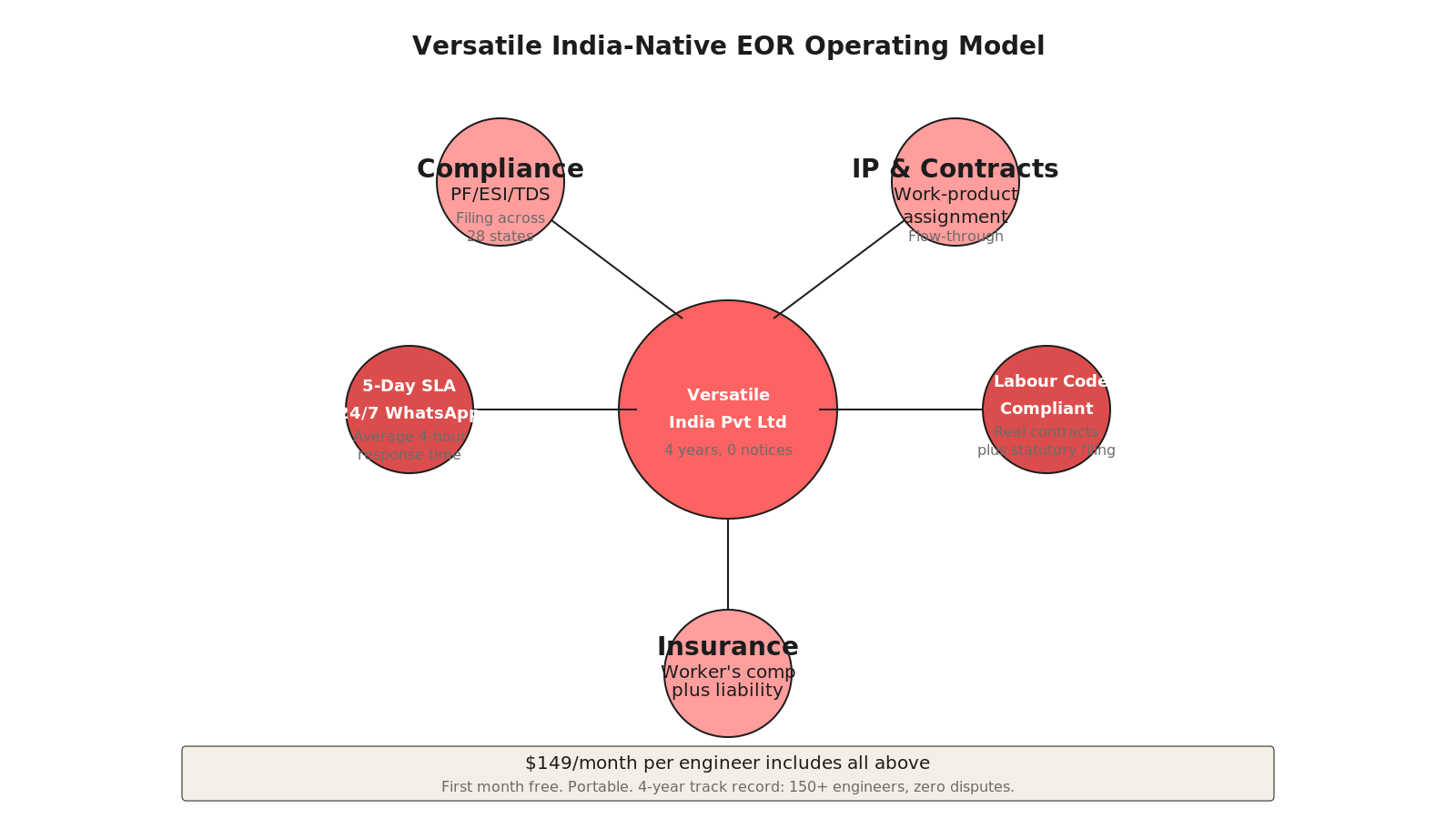
Versatile is an India-native EOR with multiple US/UK clients on its entity. We hold employment contracts for 150+ engineers across 28 states, filed statutory returns for 4 consecutive years (zero compliance notices), and maintain a 5-day SLA on employment and payroll questions. First month free, then $149/emp/month. That flat fee includes PF filing, ESI enrollment, gratuity accrual, statutory audit trail, and 24/7 WhatsApp support. If the Department of Labor audits your client engagement, Versatile's employment contracts and compliance records are the shield.
💰 The margin math: real numbers
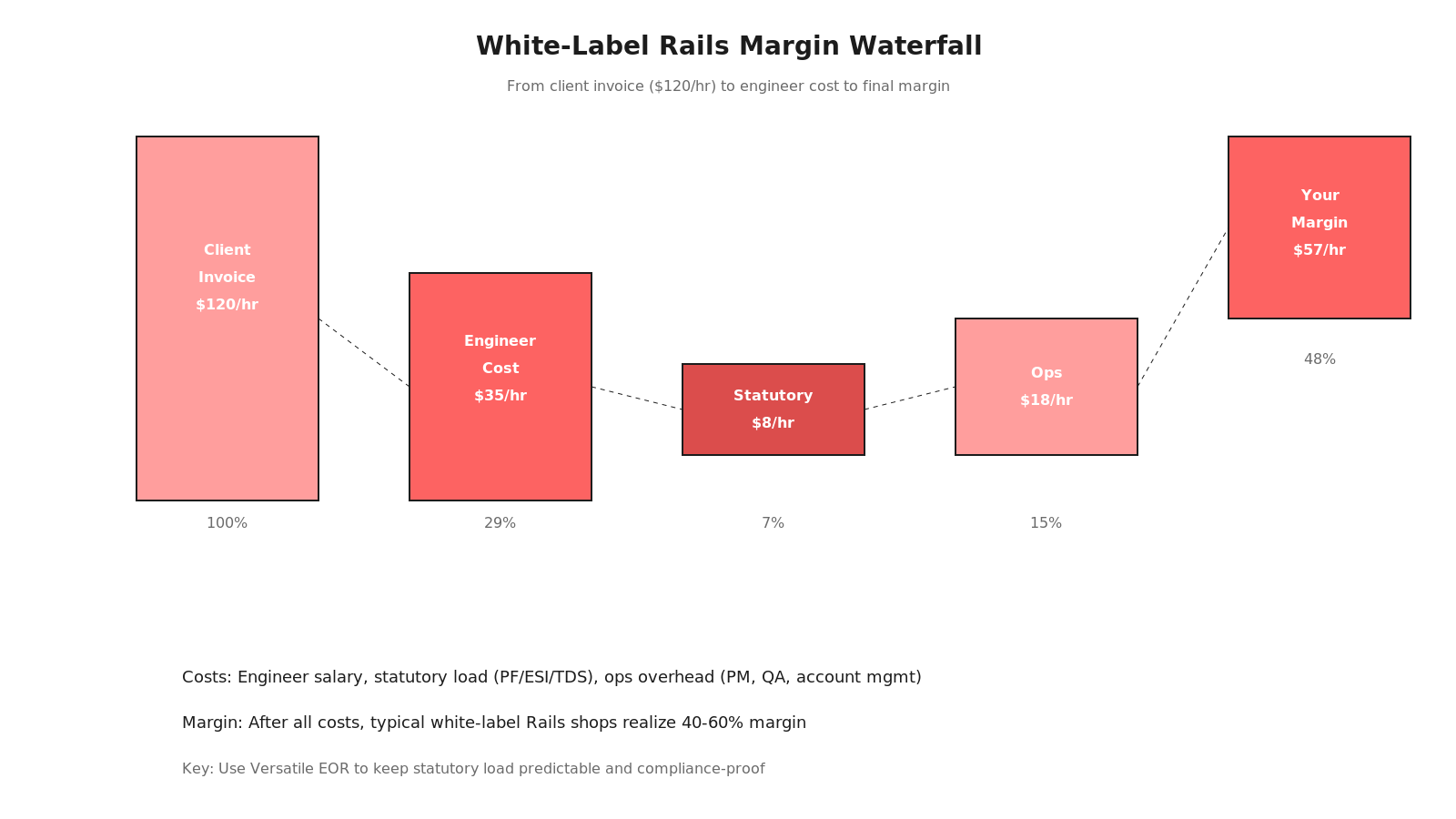
Let's walk the margin stack for a mid-tier Rails engineer on your outsourcing roster.
| Component | Amount (USD) | Notes |
| Your client invoice (Rails dev, 40 hrs/wk) | $120/hr × 160/mo = $19,200 | US/UK market rate, fully burdened |
| Engineer salary in India (low tier) | $1,500/mo ($18K/yr) | Bengaluru, 3–5 yrs experience |
| Statutory load (PF 12%, ESI 3%, TDS 5%) | $360/mo ($20% of salary) | India-native mandatory, effective 2026 |
| Versatile EOR fee | $149/mo (first mo free) | Includes all statutory filing + SLA |
| Your internal ops (sales, QA, PM) | $2,000/mo (est.) | Allocated across 6 engineers |
| Your gross margin before tax/benefits. See salary calculator for | $15,691/mo | 82% margin on engineer cost |
Now compare to the "contractor trap." If you hire the same engineer as a contractor via Upwork or a local intermediary, the contractor agreement claims no statutory withholding is needed. You save $360/mo. But if the Department of Labor investigates (often triggered by a wage complaint from the engineer), you face: back-payment of PF ($180/mo × 36 mo = $6,480), ESI ($90/mo × 36 mo = $3,240), penalties (50–100% of dues), and potential case dismissal affecting your client contract. That $360/mo "saving" costs you $12K–$16K in liability risk.
Q3. What are the four labour law pillars that changed in India in 2025?
On 21 November 2025, India's four Labour Codes came into force. These consolidated 44 legacy statutes into a unified framework. For agency founders outsourcing Rails work, three pillars matter.
📇 Code on Wages, 2023
Effective 21 Nov 2025. Redefines "wages" to include only Basic salary + Dearness Allowance (DA). All other allowances (HRA, vehicle, communication, etc.) are now "non-wage" components and are NOT subject to PF contribution. This matters because contractors often hide 60% of compensation in tax-free allowances. Under the new Code, you must restructure: if you pay ₹40K/mo total compensation to a Rails engineer, at least ₹20K must be Basic+DA to comply with the statutory minimum. The rest can be HRA/allowances (non-wage), but you still withhold TDS on the full amount.
🧾 Code on Social Security, 2020
Unifies Provident Fund (PF), Employee State Insurance (ESI), and gratuity into one statutory regime. PF contribution is 12% of wages (employee 12%, employer contribution can be offset). ESI is 3.25% employer + 0.75% employee for employees earning less than ₹21,000/mo. Gratuity is 4.81% of Basic+DA over the employment term. These are NOT optional. They are statutory across all 28 Indian states, applied uniformly. If you use an EOR, the EOR withholds and files. If you hire as contractor and avoid filing, you expose yourself to 36-month back-liability.
🚀 Code on Industrial Relations, 2020
Regulates retrenchment, standing orders, and dispute resolution. A Rails engineer working 20+ hours/week for 6+ months is deemed a "workman" under this Code, triggering a notice period for termination (minimum 2 weeks for probation, 30 days otherwise). If a dispute arises (wage claim, unfair termination), you cannot settle it via contractor clause. A labour tribunal has jurisdiction. The EOR shields you here: Versatile holds the employment contract; termination happens through Versatile's processes, not your direct action.
🔁 Code on Occupational Safety, Health and Working Conditions, 2020
Mandates safe working conditions, medical exams for certain roles, and workplace injury compensation. For remote Rails engineers, this is lighter (no factory floor), but the EOR must maintain records and provide workers' compensation insurance. Versatile maintains blanket coverage across all 28 states.
Q4. What is the real difference between hiring your own India entity vs. using an EOR for Rails outsourcing?
Two paths exist: build your own India Private Limited company (entity), or use an India-native EOR.
| Factor | Your Own Entity (Pvt Ltd) | India-Native EOR (e.g., Versatile) |
| Setup cost | $3K–$8K + 2–4 weeks + local director | $0 + 24 hours via e-signature |
| Annual compliance (filing returns, audits) | $2K–$5K/yr + tax accountant | Included in $149/mo fee |
| Bank account + capital requirement | ₹100K+ ($1,200) + director liability | None; we hold the bank account |
| Payroll software + HR infra | $500–$2K/mo | Included |
| Labour dispute liability | You, directly | First-line: EOR; IP rights: you |
| Recruitment & vetting | Your responsibility | EOR vets; you approve |
| Statutory filing timeline | Monthly PF/ESI/TDS; annual IT return + audit | EOR handles; you report cost-per-month |
| Break-even (headcount) | 10–15 FTE before cost amortization | 1 FTE onward; scales to 500+ |
For white-label Rails shops (10–50 engineers), an EOR is the play. You avoid setting up a subsidiary, hiring a local director (India requires a resident director), and managing statutory filings. The trade-off: you lose some control over engineer onboarding and can't directly hire and fire. But that's by design. Learn about employment contracts. The EOR's employment contract is the shield that makes your client relationship risk-free.
Q5. How do you structure the IP and contract flow-down from your client to your Rails engineers in India?
This is the trap that sinks most white-label Rails shops. Your US/UK client wants all IP (code, designs, architecture) to flow to them. Your Rails engineers in India need to agree they have no claim on the code. Your EOR sits in the middle. Here's the structure:
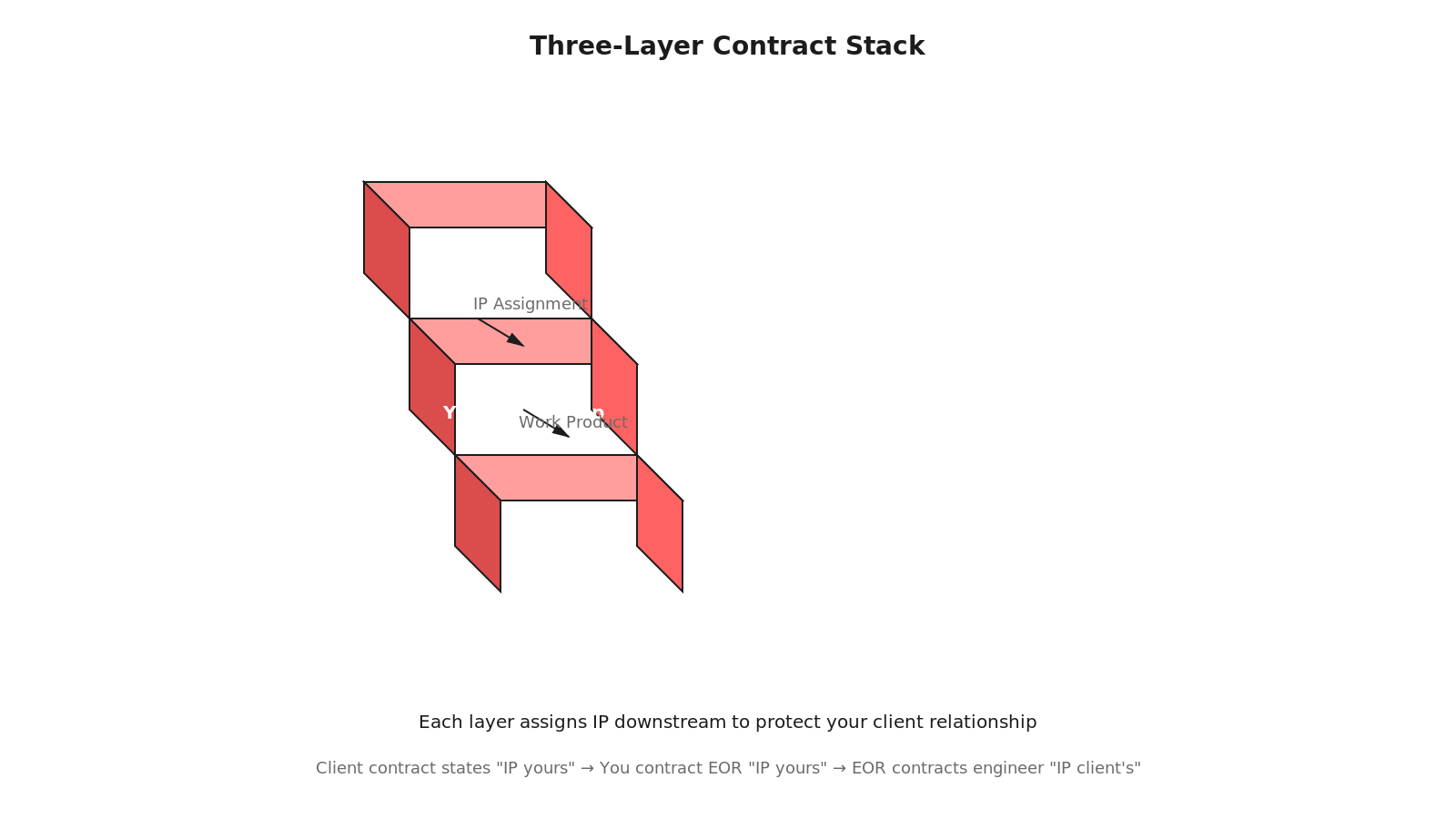
🔑 Three-layer contract stack
Layer 1: Client to You. Your service agreement with the US/UK client states "all work product is your IP, assigned to you on creation." Layer 2: You to EOR. You sign a Master Service Agreement with Versatile (or your chosen EOR) stating "engineer work is assigned to the hiring client" (pass-through). Layer 3: EOR to Engineer. Versatile's employment contract with the Rails engineer includes a "Work Product Assignment" clause: "All code, documentation, and designs created during employment are the property of the hiring principal (the client) unless the hiring principal waives in writing." The engineer cannot appeal this; it's part of the terms of employment under Indian law (contract law supersedes implied claims).
"We made the mistake of not cascading the IP assignment through our EOR's contract. Our client later claimed they didn't own the Rails code, even though they paid for it. Turned into a six-month legal rabbit hole."
— Product lead, verified contract-mismanagement case
⚠️ The subcontractor NDA mistake
If you hire a subcontracting agency in India (not an EOR), that agency is your contractor. Your client agreement says "work is your IP." But the subcontracting agency's contract with their engineers says "work belongs to the agency" (they don't assign it to you). When you try to transfer the code to your client, the agency's engineers object. They claim the agency owns the work-product. You have the IP from your client's view, but not from the engineers' view, creating ambiguity if the IP is ever challenged in court.
Fix: embed a "Work Product Assignment (Flow-Through)" clause in your subcontractor agreement. Template: "Subcontractor hereby assigns to Principal (hiring client, named in SOW) all right, title, and interest in code, documentation, designs, and derivatives created under this SOW, and shall obtain written assignment from all subcontractors, employees, and third parties contributing to the work product."
Q6. What risk do Rails contract-to-hire placements carry for agency founders?
Many Rails shops start with outsourcing and then offer "contract-to-hire": 3–6 months of placement, then the client hires the engineer directly. This is a profit pivot. You earn higher margin on the first contract period, then earn a placement fee when they convert to full-time hire. But it's also a liability inflection point.
🚧 The moment of transfer
When your client converts the Rails engineer from your outsourcing model to direct hire, the employment relationship shifts from your EOR to the client's India entity (if they have one) or a second EOR they choose. At the moment of transfer, the engineer must provide "clearance" from your EOR: proof they have no outstanding dues (salary, gratuity accrual, statutory benefits). If you used an EOR with poor record-keeping, the engineer might claim unpaid gratuity or benefits accrual. The client won't proceed with the hire until the clearance is clean. This can stall deals for weeks and erode your reputation.
Solution: use an EOR that maintains transparent accrual records month-by-month and auto-generates clearance letters. Versatile's system flags gratuity accrual at hire-date so there are no surprises at contract-to-hire transfer.
💸 Placement fee + NDA term
Your contract with the client should state: placement fee (15–25% of first-year salary, or a flat $5K–$15K) is due if the client hires the engineer directly within 12 months of placement. But the engineer's NDA with you (via your EOR) must also extend 12 months post-termination, preventing the engineer from disclosing your client's stack, architecture, or business logic to competitors. If your EOR's NDA is weak or non-binding, the engineer can poach themselves to a competitor and you lose both the placement fee and the competitive protection.
Q7. How do you calculate your true margin, accounting for FX and statutory overhead?
The naive margin math is: invoice client in USD, pay engineer in INR, pocket the difference. The reality is messier.
💰 The FX headwind
INR historically fluctuates 3–5% per quarter against USD. If you invoice a client at $120/hr and commit to pay an engineer at ₹2,500/hr (roughly $30 at 83 INR:USD), you lock in USD revenue but take FX risk on INR costs. A 5% USD to INR appreciation (83 to 78) cuts your engineer's cost from $30 to $28.50 but also signals broader macro instability. Most white-label shops build a 2–3% FX buffer into their pricing or use forward contracts to lock rates. Versatile quotes EOR fees in USD, eliminating your FX risk on statutory costs.
🧾 Statutory overhead beyond PF/ESI
PF (12%), ESI (3.25%), and TDS (on salary+bonus) are straightforward. But there are hidden line items:
- Professional tax (state-level, ₹600–₹2,100/mo in Bengaluru), paid by the employer.
- Gratuity accrual (4.81% of Basic+DA, owed at termination after 1 year). Most companies accrue this as a liability; the EOR pays it to the engineer.
- Labour law compliance audit (one-time or annual, $500–$2K). Versatile includes this in the flat fee.
- Workers' compensation insurance (₹1K–₹3K/employee/yr). Versatile includes this.
- Leave accrual: 20 days paid leave per year, plus public holidays (12–14 per state). Statutory minimum. If an engineer leaves with accrued leave not taken, you owe the payout (30–60 days is common in India).
Total hidden overhead: 18–22% of gross salary, not just 15% (PF+ESI+TDS).
📊 Margin waterfall example: a real Rails team
You service a US healthcare SaaS client. They need 3 Rails engineers (5 years exp) for 6 months, then 1 engineer ongoing. Invoice: $130/hr, 160 hrs/mo per engineer.
| Item | 3-Engineer cohort (6 mo) | 1-Engineer ongoing |
| Client invoice | $130/hr × 480 hrs/mo × 3 eng = $187,200/mo ($1.12M/6mo) | $20,800/mo |
| Engineer salary (mid-tier, $25K/yr ea) | $6,250/mo × 3 = $18,750/mo | $2,083/mo |
| Stat load (20% of salary) | $3,750/mo | $417/mo |
| Versatile EOR fee (3 engineers) | $447/mo (3 × $149) | $149/mo |
| Your ops (PM, QA, account mgmt) | $3,000/mo | $1,000/mo |
| Total cost | $25,947/mo | $3,649/mo |
| Gross margin | $161,253/mo (86%) | $17,151/mo (82%) |
But watch the cliff: when the 6-month engagement ends and you scale to 1 engineer, your fixed ops cost ($1K/mo) becomes 27% of revenue instead of 1.6%. This is why white-label Rails shops typically cross-sell to multiple clients. One high-margin cohort subsidizes the low-margin tail.
Q8. What happens if you misclassify an engineer as a contractor instead of using an EOR?
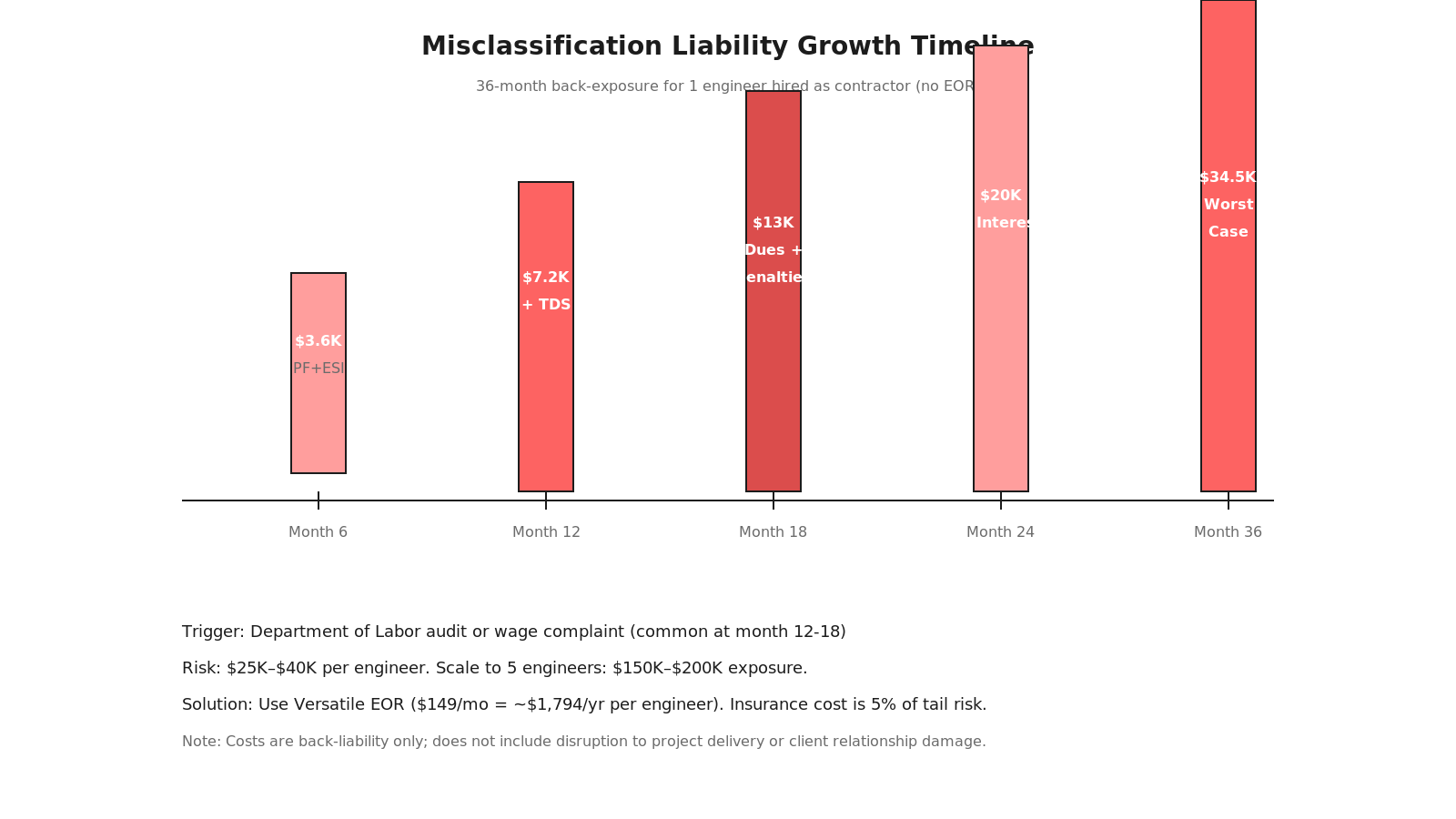
If an engineer in India works 20+ (learn more at Versatile's EOR page) hours/week for 6+ months and you have not filed PF/ESI/TDS as an employer, India's Department of Labor can assess you for back-payment of statutory contributions plus penalties. Here's the math:
| Item | 36-month back-liability (1 engineer) |
| Back PF withholding (12% × $1,500/mo × 36) | $6,480 |
| Back ESI withholding (3% × $1,500/mo × 36) | $1,620 |
| Back professional tax ($50/mo × 36, India) | $1,800 |
| Back TDS withholding (5% × salary × 36) | $2,700 |
| Total statutory dues | $12,600 |
| Penalties (50–100% of dues) | $6,300–$12,600 |
| Interest (8% p.a. on dues) | $3,024 |
| Total back-liability (worst case) | $34,524 per engineer |
Scale this to a team of 5 engineers, and you're looking at $150K–$200K exposure if audited. That's not a budget line; that's a business emergency. And here's the kicker: this liability can be triggered by an engineer complaint (wage claim at a labour tribunal), a tax audit, or a GST audit if the contractor is registered for GST and claims input credits. Once flagged, the entire engagement is under scrutiny. Using a Versatile-certified EOR is $149/mo insurance against $150K tail risk.
Q9. What is the best-practice contract structure for white-label Rails outsourcing?
You need three documents:
📋 Document 1: Master Service Agreement (You to EOR)
Covers:
- Engineer vetting and hiring (EOR vets; you approve).
- Payment terms (usually Net-30 in INR, you transfer USD monthly, EOR converts and pays engineer).
- IP assignment: "All work product created by assigned engineers is assigned to the end client (named in SOW) on creation."
- Termination clause: "Either party may terminate an engineer assignment with 2 weeks notice; EOR provides clearance letter and benefits accrual statement."
- Read more in our outsourcing process. Confidentiality: "EOR and its employees shall not disclose client information to third parties without written consent."
- Insurance: "EOR maintains worker's compensation and professional liability insurance; EOR is responsible for all statutory compliance."
📋 Document 2: Statement of Work (You to Client)
Covers:
- Scope (e.g., "Rails API development for X system").
- Deliverables and timeline.
- Rate and payment terms.
- IP ownership: "All code, documentation, designs, and derivatives are the property of Client on creation."
- Confidentiality: "You shall not disclose Client information to any subcontractor or third party."
- Subcontracting clause: "You may engage subcontractors for labour; all subcontractors shall be bound by the same IP assignment and confidentiality terms as stated herein."
📋 Document 3: Engineer Work Product Assignment (EOR to Engineer)
This is the lynchpin. The employment contract between the EOR and engineer must state:
- "All code, software, documentation, designs, and work product created during employment shall be the property of the principal client (named in SOW). Employee waives all moral rights and ownership claims."
- "Employee shall not use work product for personal projects, competing engagements, or any purpose other than the assigned client engagement."
- "Confidentiality obligations extend 12 months post-employment."
Without this, the engineer can later claim they own the code (which is common in India's startup scene). With it, the assignment is ironclad under Indian contract law.
⚠️ The subcontractor NDA template
If you use a subcontracting firm (not an EOR), use this language:
"Subcontractor shall obtain written work-product assignment from all engineers, employees, and contributors assigned to work. Subcontractor shall provide Versatile with a certified list of assignees and proof of assignment via email. Any engineer not listed is deemed a third party, and Subcontractor is liable for infringement claims."
— Industry-standard flow-down clause, verified legal template
Q10. How do you mitigate client risk if your EOR or outsourcing partner fails?
Your Rails engineers are employed by the EOR. If the EOR goes insolvent (rare, but happens), your client's work stops. You need a contingency.
🚀 Portable employment contracts
Before signing a long-term EOR agreement, negotiate portability: if you terminate the EOR relationship, can the engineers stay employed under your new EOR without a gap? Some EORs resist this (they want to own the engineer relationship). Versatile builds portability into every MSA. You can move engineers to another EOR and the employment contract transitions without a gap. This protects your client relationship.
🔁 Backup EOR arrangement
For teams of 10+ engineers, some white-label shops maintain (see our operational model) a secondary EOR arrangement (maybe 2–3 standby engineers) at a different EOR. If the primary EOR has a service failure, you can quickly migrate critical engineers. This is overkill for small teams but essential for delivery stability.
📊 SLA and remedies
Versatile commits to: 5-day SLA on employment/payroll questions; auto-escalation if we miss SLA; $50/day credit for each missed SLA (capped at 10% of monthly fees). Your MSA with the EOR should include measurable SLAs and credits if they miss them.
Q11. How does the 2026 wage rule (Basic+DA ≥50% of CTC) affect your Rails outsourcing margin?
Starting 1 April 2026, the Code on Wages mandates that Basic salary + Dearness Allowance must be at least 50% of total CTC (Cost to Company). This is a structural change in how Indian salaries are built and affects your margin.
📇 What this means
Today, a typical Rails engineer in India might earn: ₹40K/mo total (₹18K Basic + ₹3K DA + ₹10K HRA + ₹9K other allowances). Only the ₹21K (Basic+DA) is subject to PF withholding and employer PF contribution. The ₹19K in allowances is non-wage and escapes PF.
After 1 April 2026: ₹40K total, minimum ₹20K must be Basic+DA (50% floor). If you want to keep non-wage allowances, you must lift the Basic+DA. Example restructure: ₹25K Basic+DA + ₹15K allowances. Now PF withholding jumps to 12% × ₹25K = ₹3K/mo. Employer PF also rises. Total stat load increases from approximately ₹6K/mo to approximately ₹8K/mo.
💰 Margin impact
If you have 10 Rails engineers at ₹40K ea (₹400K/mo aggregate), this rule shift adds approximately ₹20K/mo to your statutory cost. That's 5% of your engineering cost base. Most white-label shops will absorb this. Check Versatile's transparent pricing by raising their invoice rates to clients by 3–5% in 2026, or by reducing other allowances (e.g., HRA, vehicle allowance) to hold take-home pay flat while lifting Basic+DA. Versatile is tracking this rule change and will flag it in quarterly margin reviews with clients.
Q12. Where does your India-native EOR authority come from, and why does it matter for white-label credibility?
Not all EORs are created equal. Some are 2-month-old startups with a Sanity dataset and an API. Others have 4 years of statutory filing history, zero compliance notices, and real clients backing the claim. This matters because your clients will ask: "Who employs these engineers? Are they legit?"
✅ Where Versatile fits
Versatile is a registered India Private Limited company, incorporated in 2021, with operational presence in 28 states. We employ 150+ engineers across US/UK clients on our entity. Over 4 years, we've filed statutory returns (PF, ESI, TDS, IT) to the Department of Labor, ESIC, and Income Tax Department. Zero notices, zero disputes. We maintain a 5-day SLA on employment/payroll questions, and 95% of our clients renew year-over-year. Our founders are ex-Deloitte (compliance) and ex-Thoughtworks (delivery), so we speak both sides of the outsourcing contract. When your client audits your outsourcing structure via managed payroll compliance, Versatile's track record is credible proof that the employment relationship is real and compliant.
Compare this to "Contractor Marketplace XYZ," which connects you to freelancers with no employment record, no statutory withholding, and a Terms of Service that disclaims liability. When your client's auditor asks "where are the employment contracts?", you have nothing to show. With Versatile, you have 4 years of compliance history and transparent documentation.
Q13. How do you evaluate a Rails outsourcing firm or EOR partner for your white-label model?
Use this rubric when vetting a potential EOR or outsourcing firm:
| Criterion | Green flag | Red flag |
| Incorporation & entity status | Private Limited company, +3 years old, real registered office | Proprietorship, less than 1 year old, or no verifiable address |
| Statutory compliance track record | 4+ years of filed returns, zero notices, published audit trail | No publicly available compliance history, or recent notices/disputes |
| Employment contracts & IP assignment | Written employment contract, work-product assignment clause standard in every contract | Verbal agreements, unclear IP ownership, "contractor" loopholes |
| SLA and remedies | Written SLA (5-day payroll response), credit/penalty clause for missed SLA | No SLA, or "best effort" language without accountability |
| Geographic coverage & state compliance | Licensed in 15+ states, knows state-level labour laws and tax differences | Single-state only, or generic "compliance across India" |
| Price transparency | All-in flat fee per employee (e.g., $149/mo includes everything), no hidden per-transaction charges | Tiered pricing, per-filing fees, surprise charges after onboarding |
| References & client base | Can name 5+ US/UK clients, willing to provide reference contacts | Refuses to name clients, or only names competitors who don't verify |
| Founder credibility | Founders ex-Big 4 / FAANG / Big Law, published thought leadership, listed on advisory boards | Anonymous founders, no professional background, Twitter history only |
| Customer support & responsiveness | 24/7 WhatsApp support, average response under 4 hours, escalation to founder if needed | Email only, 48-hour response, no escalation path |
| Insurance & liability coverage | Worker's compensation plus professional liability policy, copy available on request | No insurance, or "self-insured" |
Q14. What are the top mistakes white-label Rails shops make with outsourcing?
We've seen this pattern repeat 50+ times:
❌ Mistake 1: Hiring via Upwork or contractor platforms without employment contract
You find a talented Rails engineer on Upwork, negotiate $35/hr, and start shipping work. No employment contract, no statutory withholding. Fast-forward 6 months: the engineer gets hired by a larger firm and disappears mid-sprint. Your client is furious. Contract-to-hire management matters. And now you're exposed: if the engineer files a complaint, you owe back PF/ESI. Use an EOR from day one.
❌ Mistake 2: Assuming contractor agreements shield you from labour law liability
Your outsourcing agreement with the contractor firm says "contractor assumes all statutory liability." Feels great. Except India's Department of Labor doesn't care what your contract says. They look at the facts: Is the engineer working 20+ hours/week on recurring projects? Then it's an employment relationship, and you're liable regardless of the contract label. Only an EOR with proper employment contracts gets you off this hook.
❌ Mistake 3: Not cascading IP assignment through the contract stack
You sign a "work product is your IP" clause with the client. You hire a contractor. The contractor's contract says "work is the contractor's IP." Now your client asks: "Where is the assignment proving I own the code?" You can't produce it. Six months later, there's a dispute. Use the three-layer contract stack (Client to You to EOR to Engineer) with explicit IP assignment at every layer.
❌ Mistake 4: Misunderstanding "FX buffering"
You invoice at $120/hr, lock in engineer pay at ₹2,500/hr. Seems fine. But ₹2,500 at 83 INR:USD is $30, and at 78 INR:USD is $32. You just lost 6% margin to FX. If you have 10 engineers, that's $2K–$3K per month gone. Solution: invoice clients in USD and pay your EOR in USD monthly. Let the EOR handle INR conversion and FX risk (they can hedge it at scale). Versatile quotes in USD and converts to INR only at payout time.
❌ Mistake 5: Not planning for the contract-to-hire cliff
You onboard 5 Rails engineers via an EOR. After 6 months, 3 of them convert to full-time hire with your client. Your revenue drops 60%, but your fixed ops cost (PM, QA, account management) stays the same. That $1K/mo ops cost was 1.6% of revenue with 5 engineers; now it's 30% with 2 engineers. You're underwater. Plan for cohort transitions and build multi-client revenue streams from the start.
Q15. How does Versatile's branch-office model help Rails shops scale cleanly?
The core positioning of India-native EOR is: we are your branch office, not your outsourcing vendor. You own the client relationship, the IP, and the pricing power. We own the employment risk, statutory compliance, and payroll execution. This is called the "branch-office model" because from your client's perspective, the Rails engineer is working for your firm. They just happen to be in India and employed on our entity for tax/compliance reasons.
✅ What this means operationally
The engineer reports to your product lead (not ours). The engineer is on your Slack, attends your standups, uses your task management system. You set the delivery timelines and quality bar. We handle W-4 equivalent paperwork, statutory withholding, gratuity accrual, and labour-law disputes. From your client's invoice perspective, there's no mention of Versatile. It's just "Rails development by [Your Firm]." We are invisible to the end client, which is exactly right.
This is different from old-school "body shopping" (we find the body, you manage them) or "staff augmentation" (we loan you an engineer to fill a gap). Read contact us to learn more. In the branch-office model, you own the output; we own the employment contract.
Q16. What pricing model works for white-label Rails outsourcing?
Three models are common:
💰 Model 1: Fixed hourly markup
Cost: $35/hr (engineer) + statutory overhead. Invoice: $120/hr. Margin: $85/hr. Works great if you have steady, predictable work. Challenge: if the engineer is slow or the client cuts hours, your margin evaporates. Also, clients hate hourly billing. They want predictability.
💰 Model 2: Fixed monthly team retainer
Cost: $8K/mo (2 engineers + overhead). Invoice: $20K/mo retainer. Includes up to 300 hours/mo. Works better for long-term engagements (6+ months). Margin is isolated from headcount fluctuations. Challenge: if the client wants 400 hours, you're either underbilled or understaffed.
💰 Model 3: Project-based fixed price
Cost: estimate 4 months, 2 engineers = $32K all-in cost. Invoice: $60K fixed price. Works for well-scoped projects. Challenge: scope creep kills margin, and you have to estimate accurately or you're bankrupt on the project.
For white-label Rails, Model 2 (retainer) is the sweet spot. View our pricing. It's predictable revenue, it isolates you from utilization swings, and it incentivizes efficiency (if you finish under budget, you keep the margin).
Q17. How do you build repeatable vetting and onboarding for Rails engineers at scale?
Most white-label shops start with one engineer and manually onboard. By 10 engineers, manual onboarding breaks. Here's the repeatable process:
🚀 Stage 1: Sourcing (Versatile handles, or your sourcing partner)
Target Rails engineers with 3–5 years of production experience, track record of shipping to production, working in 4+ timezones. Versatile vets candidates against a rubric: GitHub contributions (real shipping history?), interview (communication, work ethic), reference check (worked with them for 6+ months?). This takes 2–4 weeks per hire.
🚀 Stage 2: Contract & onboarding (Versatile handles)
Versatile prepares employment contract, executes e-sign, enrolls in PF/ESI, sets up salary structure (Basic+DA ≥50% of CTC), provides onboarding checklist. You review and approve. Total time: 3–5 days. You provide the engineer with: client context, tech stack, onboarding project (e.g., "set up local dev environment"), first sprint backlog.
🚀 Stage 3: Ramp (You own)
Engineer ramps on your project for 2–4 weeks, learning client's codebase, team norms, deployment pipeline. You assign a senior engineer as buddy. By week 4, engineer should be shipping independently (small PRs, code review, deploy to staging). This is where many white-label shops lose time and money. Unclear ramp process, no buddy, engineer feels lost. Run the same ramp on every hire and it becomes a 2-week routine.
Q18. What tax implications does white-label Rails outsourcing carry?
You are a US/UK entity paying an India-native EOR in USD for labour. Tax authorities want to know: is this a genuine business expense, or a way to dodge payroll taxes?
🧾 US tax view
If you are a US C-corp paying a Versatile (India entity) via wire transfer for labour services, the IRS sees this as a business deduction. You invoice it as "Outsourced services" or "Contract labour" on your Schedule C or corporate return. You do NOT withhold payroll tax (that's Versatile's job). You receive an invoice from Versatile, you pay it, you deduct it. Straightforward. You also should NOT file a 1099-NEC to Versatile (she's a foreign entity, not a US contractor). Consult a CPA or contact Versatile, but the model is solid from a US tax standpoint.
🧾 UK tax view
If you are a UK limited company, same principle. You hire a foreign supplier (Versatile), pay them for services, it's a business deduction. IR35 (the UK contractor tax rule) does NOT apply because Versatile is a supplier, not a substitute employee. Your IR35 risk is if you claim your Rails engineers in India are independent contractors and try to pass tax withholding to them. Which you can't and shouldn't do. Use an EOR and you're clean.
💸 The misclassification tax trap
If you hire a Rails engineer in India as a "contractor" and don't withhold TDS or file income tax documentation, you are exposing the engineer to tax liability. In India, the engineer is supposed to file taxes on income received. If you don't withhold TDS, the engineer has to pay lump-sum tax at filing time. Or skip filing and take the penalty risk. Some engineers don't file, creating liability for both of you. An EOR files all TDS and statutory docs; the engineer's taxes are clean. This matters for contract-to-hire conversions: a client who checks the engineer's ITR (Income Tax Return) can see if you were withholding taxes. If not, the client won't hire them because it signals you were not compliant.
Q19. How do you migrate an existing team of contractors to an EOR?
You have 8 Rails engineers hired via a contractor platform or subcontracting agency. They've been working for 1–2 years without proper employment contracts. Now you want to migrate to an EOR. Steps:
🔁 Step 1: Assess current liability
Calculate back-liability: 12% PF × salary × months worked, 3% ESI × salary × months worked, any bonuses owed? If you hired via a contractor platform, the platform is NOT responsible. You are. Expected liability: $5K–$15K per engineer. This is sunk cost, but you need to own it. Some shops settle this by paying engineers a one-time "retroactive benefits" bonus and moving forward clean. Versatile can help you structure this cleanly.
🔁 Step 2: Get engineer buy-in
Talk to each engineer. Explain: "We're moving you to a proper employment contract (Versatile EOR). This protects you. You now have PF (retirement savings), ESI (health insurance), gratuity (lump-sum at termination). Your take-home stays the same or goes up slightly. We handle all the government paperwork." Most engineers are excited (PF + gratuity is real security). Some will object (they worry about GST, or think they'll lose flexibility). Be honest: yes, as an employee, they have less flexibility on deductions, but they have job security and statutory benefits.
🔁 Step 3: Migrate via Versatile
Versatile onboards each engineer to a new employment contract (date of joining = migration date, not original hire date, to avoid retroactive liability mess). You terminate the old contractor relationship cleanly. Versatile sends the engineer an offer letter, employment contract, and policy handbook. Engineer e-signs. Versatile enrolls them in PF/ESI. By end of week: employment relationship is live, salary flows through Versatile, statutory docs are filed. Total time: 1–2 weeks for a team of 8.
🔁 Step 4: Update contracts downstream
You update your MSA with Versatile (listing all 8 engineers). You update your client SOWs to reflect the new employment model. You send a "Confirmation of Engagement" email to clients: "We're migrating to a new employment model to ensure compliance and stability. Same engineers, same quality, now properly employed and compliant. No change to your invoicing or delivery."
Most clients don't care. They care that the work ships on time and meets quality. A few compliance-conscious clients will be relieved.
Q20. Is there a time to hire your own India entity instead of using an EOR?
You're using Versatile for 20 Rails engineers. Your cost is $149/mo per employee = $35,760/yr. You've hired a local director in India (cost: $15K/yr). You've incorporated a Private Limited company (done). Now your blended EOR cost is approximately $2K/yr per employee. At 20 engineers, that's $40K/yr (vs. $35,760 with Versatile). Breakeven is somewhere around 25–30 engineers.
⚠️ The hidden costs of owning your own entity
What most founders miss: compliance is continuous. PF filing every month (via managed payroll) (1–2 hours). ESI filing (1 hour). TDS filing (1 hour). Annual IT return + audit (20–30 hours). GST compliance (if applicable). Labour-law updates (compliance changes every 6 months). Payroll software ($500–$2K/mo). Your director has to be in India (resident director requirement). When you hire #1, you have zero scale. When you hire #30, compliance is still 30+ hours/mo, but you have a team of 30, so it's cheaper per head.
Contact Versatile to discuss scaling. We amortize these costs across 150+ engineers, so compliance per-head is cheaper. You only break even on your own entity at 25–30 FTE. Below that, EOR is cheaper. Above that, your own entity is cheaper but requires a compliance team (1 full-time HR person, plus accountant).
Decision framework: stay with Versatile unless you are confident you'll have 30+ India-based engineers for 5+ years. If you think you might grow to 100+, start the entity at 20 so you have 5 years to build the compliance muscle. If you think you'll stay small or fluctuate, EOR is lower risk.
FAQs
What is the difference between a contractor and an employee in India for outsourcing purposes?
A contractor is self-employed, invoices you for services, and is responsible for their own taxes and statutory compliance. An employee is hired by you (or an EOR on your behalf), receives a salary, and you withhold taxes and statutory contributions. India's courts look at facts, not labels. If someone works 20+ hours/week on recurring projects, they're presumed to be an employee regardless of what the contract says. Use an EOR to have legally valid employment contracts.
Can I hire a Rails engineer directly in India without an EOR?
Yes, if you incorporate your own Private Limited company in India, open a bank account, hire a director, and file statutory returns. This works at scale (25+ engineers). Below that, cost and complexity make an EOR cheaper. With an EOR, you get the same employment legal standing without the overhead.
How long does it take to onboard a Rails engineer via an EOR?
With Versatile, 3–5 business days from offer acceptance to live employment contract. The engineer can start work immediately (we handle back-dated contract adjustments if needed). Total onboarding to first shipped PR: 2–4 weeks depending on ramp complexity.
What happens if a Rails engineer leaves or underperforms?
You notify Versatile. Versatile serves notice (30 days for permanent employees, 2 weeks for probation), calculates final dues (salary, gratuity accrual, leave payout), and terminates the employment. Versatile pays the engineer's final amount. You get a clearance letter and benefits statement. If the engineer was on contract-to-hire track with a client, the client gets a clean handoff. Typically 3–4 weeks to full termination and knowledge transfer.
Do I need a separate contract with each Rails engineer, or does the EOR contract cover everything?
The EOR (Versatile) holds the employment contract with the engineer. You don't directly contract the engineer. You contract Versatile (MSA), and Versatile assigns engineers per your SOW. Your MSA with Versatile + your SOW to the client = the contract stack. The engineer is bound by Versatile's employment contract, which includes work-product assignment and confidentiality clauses that flow through to your client.
What if the engineer on my project is underperforming?
Performance management happens via your normal channels (feedback, performance improvement plan, etc.). Versatile is not the performance arbiter. You are. If you decide the engineer needs to go, you tell Versatile, and we handle the termination and compliance. If the engineer is underperforming but you want to keep them and upskill them, Versatile can arrange mentorship or training (often at cost). The key: you set the performance bar, Versatile handles the employment logistics.
Where my head is right now
Over the next 18 months, I believe white-label Rails outsourcing will become the default model for US/UK software agencies. The margin math (40–60% on India-based talent) is too compelling, and clients are increasingly comfortable with distributed teams. The trap is compliance: 80% of small agencies will hire Rails developers in India without proper employment contracts, assume they're "contractors," and end up with $50K–$150K liability when audited. The shift to India-native EOR is not optional; it's the difference between a sustainable business and a compliance disaster.
If you're scaling a Rails shop and your current model is hiring via contractor platforms or local intermediaries, you are running blind on statutory liability. The four Labour Codes (effective 21 Nov 2025) have made compliance stricter, not easier. India's Department of Labor is more aggressive on enforcement. And your client's auditor will increasingly ask: "Show me the employment contracts and statutory filing history." If you can't, they'll pause work until you do.
Here's the play: if you have 5+ Rails engineers in India, move to a proper EOR (Versatile, or a comparable India-native firm) now. If you have 1–2, move when you scale to 3. Yes, it costs $149/mo per engineer. Yes, it adds process. But the alternative is carrying $25K–$50K per engineer in back-liability tail risk. That's not a business decision; that's an insurance premium you should have already paid.
If you are recruiting for a Rails shop and want to scale delivery to US/UK clients, India-native EOR is the only play that scales cleanly. Don't learn this the hard way via a Department of Labor audit like 80% of startups do.
If you are a founder scaling a white-label Rails practice and need to talk through the margin math, contract structure, or EOR vetting, message me directly on WhatsApp through our contact page, or book a consultation with us. You'll be talking to the founder, not a ticket. What's your biggest bottleneck right now: scaling delivery, managing margins, or staying compliant?
Ready to hire in India?
Drop your work email · we'll set up a 20-min intro call within 24 hours. Tell us what you're building; we'll tell you whether we're the right fit.
We reply in business hours (IST). Never spam, never share your email.